Chicken farm RO water treatment system 1T-2T
1–2 Ton/Hour RO Water Treatment System: Standard Components, Supported Chicken Capacity & Applicable Water Supply Systems
I. Full Standard Configuration of 1–2t/h RO Reverse Osmosis Water Purification Equipment (Specialized for Poultry Drinking Water)
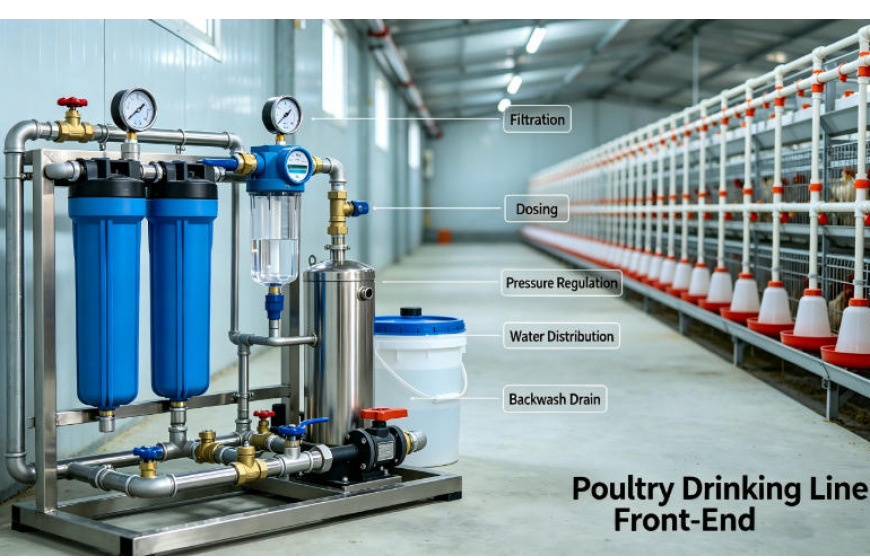
The system consists of four major modules: pre-treatment unit, core RO host unit, finished water supply unit, and electric automatic control unit. It purifies drinking water for chickens by removing sediment, limescale, heavy metals, bacteria and impurities to protect nipple drinker pipelines.
1. Pre-treatment System (Front Filters to Protect RO Membranes)
Raw water booster pump: self-priming pump / pipeline pump for pressurizing well water or municipal tap water
Raw water tank (optional): 1–3m³ PE tank to stabilize fluctuating inflow
Multi-media filter (quartz sand tank): intercepts sediment, rust and suspended solids
Activated carbon filter: absorbs residual chlorine, odors and organic matter to prevent oxidative damage to RO membranes
Precision security filter (5μm PP cotton filter cartridge): final impurity interception to safeguard RO membranes
Automatic backwash valve: enables automatic forward & reverse washing of sand and carbon tanks to cut manual maintenance
Scale inhibitor dosing device (standard): mandatory for high-hardness well water to avoid membrane scaling and blockage
2. Core RO Reverse Osmosis Host Components
High-pressure RO booster pump: generates required reverse osmosis pressure (1.0–1.6MPa)
Membrane housing: 1 piece of 4040 membrane for 1t/h unit; 2 pieces of 4040 RO membranes for 2t/h unit
4040 commercial RO membrane elements: salt rejection rate ≥97%, removes limescale, bacteria, calcium and magnesium ions
Automatic membrane flushing valve: auto-flushes membranes after shutdown to extend service life
Concentrate regulating valve, product water flowmeter, concentrate flowmeter: adjusts water recovery rate (50%–60% recommended for farms)
High/low pressure protection switches: auto-shutdown under low water pressure or high membrane blockage pressure to protect pumps and membranes
3. Post-stage Finished Water Supply Unit
Purified water tank: 1–3m³ PE storage tank for treated qualified drinking water
Variable frequency constant-pressure water supply pump / delivery booster pump: provides stable pressure for poultry drinking pipelines
UV sterilizer (optional, highly recommended for farms): eliminates bacteria and algae growing inside water tanks
Ozone generator (optional): inhibits bacterial growth in water and reduces biofilm clogging in pipelines
Pipes, valves, pressure gauges and conductivity meter (real-time water hardness monitoring)
4. Electric Automatic Control System
PLC / microcomputer control cabinet, automatic start-stop, high/low pressure protection, water shortage alarm, full-tank shutdown and automatic flushing program.
II. Supported Chicken Raising Capacity for 1t/h & 2t/h RO Units (Only for Drinking Water Purification, Excluding Manure Sewage Treatment)
Basic Reference Data
Daily water consumption per broiler: 0.002–0.003 m³/head (take upper limit under high summer temperature)
Daily water consumption per layer: 0.0025–0.0035 m³/head
Effective daily water supply hours: 20 hours per day (4 hours reserved for pipeline flushing and equipment maintenance)
1. 1 Ton/Hour RO Equipment (1m³/h Product Water)
Total daily purified water output = 1 × 20 = 20 m³/day
Broilers (summer peak water demand): 20 ÷ 0.003 ≈ 6,600 heads
Layers (summer peak water demand): 20 ÷ 0.0035 ≈ 5,700 heads
Safe recommended stocking capacity: ≤6,000 broilers, ≤5,000 layers
2. 2 Ton/Hour RO Equipment (2m³/h Product Water)
Total daily purified water output = 2 × 20 = 40 m³/day
Broilers: 40 ÷ 0.003 ≈ 13,300 heads
Layers: 40 ÷ 0.0035 ≈ 11,400 heads
Safe recommended stocking capacity: 10,000–12,000 broilers, 9,000–11,000 layers
Supplementary Margin Notes
Water for wet curtain cooling, vehicle washing and disinfection uses raw water separately, independent of RO purified water;
Frequent pipeline disinfection and medication addition shall reduce the maximum stocking capacity by 15%;
For extremely high-hardness well water with fast product water attenuation, operate the equipment at 80% rated load.
III. Applicable Water Supply Systems Matched with This RO Purification System
1. Core Application: Chicken Drinking Water Supply (Primary Matching Scenarios)
Automatic drinking pipelines with nipple drinkers for multi-layer cage raising
Automatic drinking pipelines and hanging cup drinkers for net floor rearing
Constant-temperature drinking water supply for brooder houses (chicks are sensitive to water quality, RO purified water is preferred)
Drinking water supply for breeder cages and purified water for humidification in hatcheries
2. Auxiliary Purified Water Scenarios
Purified water for vaccine dilution (prevents calcium & magnesium ions from deactivating vaccines)
Purified water for workshop atomization cooling & mist disinfection (avoids nozzle blockage from limescale)
Purified water for egg washing (no white limescale marks left on eggshells)
Pure water supply for farm laboratories and veterinary testing
3. Systems Not Suitable for RO Purified Water (Raw Water Bypass Required)
Manure flushing, floor cleaning and vehicle washing (direct well water / raw water to avoid waste of RO product water)
Cooling pads circulating water supply (huge water consumption, raw water is sufficient)
Manure treatment, septic tank water replenishment and green irrigation